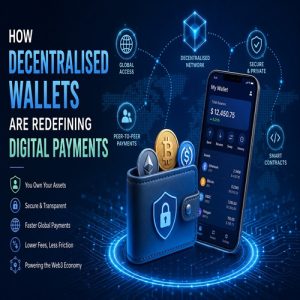
Overview:
The rapid development of blockchain technology is changing the way digital assets are stored, transmitted and controlled. One of the core aspects of this change involves the rise of decentralised wallets that will allow users more control over their assets without going through any intermediaries in the financial sector.
What Is a Decentralised Wallet?
Decentralised wallets, also known as non-custodial wallets, allow individuals to manage their digital assets using private keys or seed phrases. As opposed to regular digital wallets, which involve banks, payment gateways or exchanges managing user funds, decentralised wallets allow individuals to manage their funds independently.
Funds are kept and tracked on the blockchain network, as opposed to being kept in a single centralised entity. This could be the future of digital payments because of transparency, programmability and cross-border transactions.
More Control Over Cryptocurrency:
One of the main benefits offered by decentralised wallets is that of users’ control over digital assets. The use of such wallets eliminates the need to depend on an external third party to store one’s crypto and confirm every transaction.
However, such self-custody entails more user responsibility since forgetting the private key or phrase may mean loss of access to assets. Faster and Easier Payment Services
Peer-to-peer transactions can become possible through decentralised wallets without the involvement of banks. Depending on the specific blockchain network and the nature of transactions, payments can be made all week round, including weekends and holidays.
The ability becomes especially useful for international transactions. Using decentralised wallets allows people to transfer supported digital assets internationally without relying solely on existing payment channels.
Reduced Payment Friction:
Conventional payment mechanisms often have numerous intermediaries involved, accounts required and various procedures that have to be followed. Decentralised wallets help facilitate some of these procedures by enabling users to interact directly with blockchain networks.
This enables businesses to use digital assets as well as explore new payment schemes. Using smart contracts, some of the transactions can be automated according to specific terms. Thus, blockchain-based payments can be beneficial for applications like marketplaces, subscriptions, and decentralised finance systems.
Enhanced Transparency and Security:
The transactions made using blockchains are normally registered in the distributed ledger. This allows one to verify the transaction history independently, which provides greater transparency at the time when transaction details are managed by a centralised institution.
Decentralised wallets may offer security mechanisms such as private-key ownership, encryption, integration with hardware wallets, and multi-factor authentication, among others. Decentralisation doesn’t necessarily equal security due to the presence of phishing attacks, malware, device hacking, and the stealing of the recovery phrase.
How Do Web3 and Digital Commerce Gain from Decentralised Wallets?
Apart from serving as a payment system, decentralised wallets act as the entry point for the entire Web3 ecosystem where users can interact with dApps, decentralised exchanges, NFT marketplaces, blockchain games, and DeFi applications.
In the age of digital commerce, wallets might become programmable financial interfaces instead of just the storage of digital assets. The user will be able to conduct payments, handle credentials, membership, and other digital assets via the wallet interface.
Challenges to Consider:
Decentralised wallets have numerous benefits; however, there are also challenges to keep in mind. However, the usage of decentralised wallets may seem quite difficult for new customers because of private key management, network fees, and recovery phrases, among other factors.
Blockchain scalability, network fees, and congestion may affect the efficiency of the payment process. In addition, it is important to take into account regulation in case of businesses that adopt blockchain-based payment solutions.
The Future of Decentralised Payment Methods:
Decentralised wallets are revolutionising the field of digital payments by transferring the authority from intermediaries to the end-user through blockchain technology. They have capabilities that allow for peer-to-peer transactions, global access, programmable transactions, and Web3 applications, which make them more pertinent for the future of digital payments.
If decentralised wallets become more scalable and user-friendly, they can be integrated into mainstream payment methods. The future success of decentralised wallets relies on making improvements in security, ease of use, regulation and interoperability. Decentralised wallets are a big step towards a user-owned digital finance system for business people and consumers seeking the future of digital payments.
Frequently Asked Questions:
- What is a decentralised wallet?
A decentralised wallet is a digital wallet that allows users to manage their cryptocurrency and other blockchain-based assets while maintaining control over their private keys. It enables users to send, receive, and store digital assets without relying entirely on a centralised financial intermediary.
- How are decentralised wallets changing digital payments?
Decentralised wallets are transforming digital payments by enabling peer-to-peer transactions, supporting blockchain-based payments, and reducing dependence on traditional intermediaries. They can also facilitate cross-border transfers and provide users with greater control over their digital assets.
- How do decentralised wallets work?
Decentralised wallets use cryptographic keys to authorise transactions on blockchain networks. Users initiate a transaction, sign it with their private key, and broadcast it to the network for validation. Once confirmed, the transaction is recorded on the blockchain.
- What is the difference between centralised and decentralised wallets?
Centralised wallets typically rely on a service provider to manage users’ assets or private keys, whereas decentralised wallets generally allow users to retain control of their private keys. The main differences involve asset custody, user control, recovery options, and responsibility for security.
- Are decentralised wallets safe for digital payments?
Decentralised wallets can provide strong security through cryptographic protection and user-controlled keys. However, their safety depends on secure key management, wallet software, and user practices. Phishing attacks, malicious applications, and lost private keys can result in financial losses.
- Can decentralised wallets support cross-border payments?
Yes. Decentralised wallets can facilitate cross-border transfers of supported cryptocurrencies and digital tokens through blockchain networks. Transaction costs, processing times, exchange rates, and regulatory requirements vary depending on the network, asset, and destination.
- What are the benefits of decentralised wallets for businesses?
Decentralised wallets can help businesses accept supported digital assets, facilitate peer-to-peer payments, access blockchain-based financial services, and explore international payment options. They may also improve transaction traceability, depending on the blockchain network and payment process.
- Do decentralised wallets require a bank account?
Many decentralised wallets can be created and used without a traditional bank account. However, converting digital assets into fiat currency or transferring funds to a bank may require an exchange, payment provider, or other regulated service.
- What are the main challenges of using decentralised wallets for digital payments?
Key challenges include private key management, limited consumer protection in some situations, transaction fees, price volatility, varying merchant acceptance, regulatory requirements, and the complexity of blockchain technology for new users.
- What is the future of decentralised wallets in digital payments?
Decentralised wallets may increasingly support multi-chain transactions, stablecoin payments, decentralised finance applications, digital identity services, and improved recovery features. Their wider adoption will depend on better usability, stronger security, interoperability, and regulatory clarity.