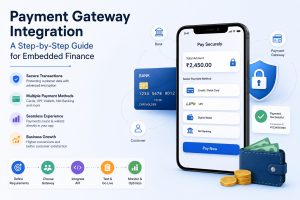
Introduction:
Embedded finance is altering the way in which financial services are delivered by businesses to their clients. Clients today have the ability to pay, borrow, and utilise digital wallets directly on the business website or its mobile application. All of this is enabled through payment gateway integration technology. Payment gateway integration technology enables businesses to receive secure payments online while retaining the efficiency and speed of the process.
Below is a guide to the procedure of integrating a payment gateway for embedded finance.
What is Payment Gateway Integration?
A payment gateway is a service that handles online payments in a fully secure manner. It acts as an intermediary between the customer, business, banks, and payment processor to complete the transaction in a safe manner. Also, it ensures that the payment details are encrypted.
With payment gateway integration in embedded finance, businesses get the ability to integrate payment functionality into their platform or app itself. This provides the user with an easy transaction experience without redirecting to another website.
Why is it important for a payment gateway?
A payment gateway is one of the most important elements of any embedded finance solution. It helps businesses to:
• Process payments fast and safely
• Offer multiple ways of paying
• Limit the number of abandoned shopping carts
• Boost the level of client satisfaction
• Generate more sales and profits
• Easily process increasing volumes of transactions
Regardless of whether you operate an eCommerce website, fintech service, software-as-a-service company or online marketplace, a payment gateway can enhance the payment experience dramatically.
Step 1: Assess Your Business Requirements:
It is among the most important things that you should do prior to selecting a payment gateway. You should take into account such aspects as the following:• In which countries do you offer your services?
• Which payment methods do your clients use?
• Do you require recurrent payments?
• How many transactions do you expect?
• Which crucial security and regulatory requirements do you have to comply with?
Step 2: Choosing a Suitable Payment Gateway:
Each payment gateway is built with some unique features which are not available with other gateways. It is crucial to choose a payment gateway that provides the following features:
• Easy integration of API
• The ability to make payments using various modes
• Able to provide strong security features
• Equipped with tools to check fraud
• Compliance with PCI DSS standards
• Supports multiple currencies for payments
• Provides reliable customer support
Using an easy-to-integrate and scalable payment gateway will help in saving a lot of time as the company expands.
Step 3: Obtaining API Credentials:
Once you have registered with a particular payment gateway service provider, you will be provided with API credentials such as API keys and merchant information. These credentials help in making an appropriate connection with the payment gateway service.
Step 4: Integrating the Payment Gateway:
The developers can use their APIs or SDKs provided by the payment gateway service provider to integrate the payment gateway into their website.
Integration of the payment gateway involves:
• Authentication
• Payment request
• Payment response
• Refund
• Status update via webhooks
The most important aim of payment gateway services is to ensure that the payments are hassle-free.
Step 5: Ensuring Security for Payments:
Security for the personal and confidential details of the customers is of utmost importance. You must have in your payment gateway:
• SSL encryption
• Payment tokenisation
• PCI DSS compliance
• Secure API authentication
• Fraud prevention
These steps will help secure the data of your customers and prevent fraud.
Step 6: Test Before Going Live:
Having gone through all the processes mentioned above, when ready to accept payments on the site, it is critical to test the payment gateway to see if everything works fine:
Test under different conditions, such as:
• When the payment is made successfully
• When the payment does not go through
• The conditions under which the transaction is declined, refunds
• How to deal with the problem: Testing these scenarios will help identify any issues that need to be resolved before customers use the payment gateway.
Step 7: Go Live:
After successfully completing the tests, it is time to go live and start receiving payments.
Continuously monitor your payment process for:
• Successful transactions
• Failed payments
• Time needed to process payments
• Any fraud warnings
• Customer feedback
Best Practices:
In order to achieve the best outcomes from integrating a payment gateway:
• Simplify the payment process.
• Support a number of different payment options.
• Optimise mobile payments.
• Make updates to APIs regularly.
• Assess payments’ performance.
• Adhere to the most up-to-date security guidelines.
This will help establish trust with customers and ensure a higher success rate of payments.
Conclusion:
Integrating a payment gateway is a crucial component of embedded finance. This helps businesses to provide their customers with secure, efficient and convenient payment services directly in their platforms. Integrating the proper payment gateway using the appropriate procedures and ensuring that the process is secure will help businesses to deliver the best experience in payments to their customers.
Frequently Asked Questions (FAQs):
What is a payment integration gateway?
A payment integration gateway is the process of integrating any website or mobile app with a payment gateway to facilitate the secure processing of online payments. The integration ensures that users can make online payments through different methods without compromising the security of the transaction.
Why is payment gateway integration critical in embedded finance?
It becomes possible for businesses to provide customers with easy ways of making payments by integrating the payment gateways into their own platforms. As a result, transactions are carried out faster with a better user experience and higher conversion rates.
How does the payment gateway work?
Payment gateways work as a bridge between the customers, the merchants, the payment processors, and the banks. They securely encrypt the data from the payment and process the transactions.
What parameters must be considered before choosing a payment gateway?
The parameters which the business must consider when choosing a payment gateway include the type of payments it can accept, countries of operation, whether it offers recurring payments, its transaction limit, APIs, security measures, fraud prevention, PCI DSS, multiple currency support, and customer support.
What are API credentials in payment gateway integration?
‘API credentials’ refer to the codes for authentication, which are issued by the payment gateway provider, which facilitate the integration between the application and the payment gateway via their APIs.
What are some of the essential security considerations for every payment gateway?
Some of the basic security considerations that need to be kept in mind for every payment gateway include SSL Encryption, Payment Tokenisation, PCI DSS Compliance, Secure API Authentication, etc.
Why is testing of the payment gateway necessary before going live?
It is important to test the payment gateway so that you can be sure that it works properly in cases where there is a successful payment, failure, decline of payment and refund.
Which payment methods should be offered by a modern payment gateway?
The payment gateway should be able to accept various forms of payments, such as credit or debit card payments, digital wallets, UPI payments, bank transfer payments, net banking, BNPL (buy now pay later) services, and others, so as to ensure the greatest possible convenience for the customer.
What are the benefits of having a payment gateway integration?
There are many benefits that can be attributed to the payment gateway integration, such as safe and quick transactions, various payment methods, a lower cart abandonment rate, greater customer satisfaction, an increase in sales, safety from fraud, and scalability of the system.
What are some of the best practices that should be followed while integrating payment gateways?
It is suggested that some of the best practices should include simplified checkout procedures, multiple payment options, optimisation for mobile devices, updated APIs, transaction performance management, PCI DSS compliance, and advanced fraud protection features.
Do payment gateways offer international payment options?
Yes. Some of the payment gateways can facilitate international payments due to the presence of multi-currency options and other payment methods across borders.
For whom is payment gateway integration essential?
Payment gateway integration is beneficial to eCommerce businesses, fintechs, SaaS providers, online marketplaces, subscription-based businesses, digital wallets, and all kinds of organisations that take online payments via websites and mobile applications.