Introduction:
Banking is not confined to bank branches, their websites, or specialised financial apps any more. Nowadays, people are able to carry out payments, get credit, receive payments, manage their money, and use a variety of other financial services while they are shopping, working, travelling or making use of their preferred digital platforms. The reason for this change is embedded finance, since it enables non-financial companies to incorporate financial services directly into their products and customers’ experiences.
What Is Embedded Finance?
Embedded finance means integrating financial services into non-financial platforms, applications, and business processes; rather than asking customers to leave a retail website or a business app and go to a bank, companies can offer the relevant financial services within their own digital environment.
Such services may cover payments, digital wallets, lending, insurance, bank accounts, debit or credit cards, and other financial products. The financial infrastructure is usually made available by banks, fintech companies,
Banking-as-a-Service (BaaS) providers and APIs:
For instance, an e-commerce website can allow its customers to choose instalment payments when checking out, while a business software company can give merchants access to payment accounts or working-capital financing without them having to use a separate financial application.
How Non-Financial Brands Offer Banking Services:
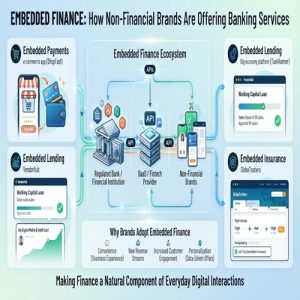
Most non-financial companies do not set up as banks for themselves but rather deal with licensed financial institutions and technology providers. A typical embedded finance ecosystem consists of three main participants. The regulated bank or financial institution offers the basic financial products and is responsible for the regulatory framework. A BaaS or fintech infrastructure provider links these services together using APIs. The non-financial brand then incorporates the services into its website, app, or software.
The model enables businesses to concentrate on their customers whilst specialist partners look after areas such as payments, account infrastructure, compliance, fraud prevention, and financial operations.
Common Examples of Embedded Finance :
Embedded payments are the most common type of example. Companies that operate online marketplaces, food-delivery services, travel websites, and e-commerce sites enable customers to make payments without having to be redirected to a different financial service.
Another area in which embedded lending is becoming increasingly common is that businesses are able to provide financing options when needed by using customer or transaction data. For example, an e-commerce platform might give a merchant a working-capital loan based on the merchant’s sales activity.
With embedded banking, platforms are able to offer a range of services such as accounts, cards, money management, and payouts within their own environments. This is especially beneficial for marketplaces, gig-economy platforms, and business software providers.
Embedded insurance allows companies to provide insurance that is relevant to an ongoing transaction. Instead of directing customers to a separate insurer, travel companies, vehicle platforms, and online retailers can include insurance options.
Why Brands Are Adopting Embedded Finance:
The main benefit is convenience since customers are able to use financial services whenever and wherever they need them rather than having to switch among various applications; this in turn leads to a more seamless digital experience and helps to decrease the friction involved in transactions.
Embedded finance can also open up new sources of revenue for businesses. They will be able to make money from offering financial products at the same time as they improve their relationships with their current customers. Moreover, financial services can boost engagement and get customers to spend more time using the features of the company’s ecosystem.
A further benefit is personalisation. Since the platform is already familiar with its customers’ activities and transactions, it can use relevant data to show financial products that suit customer needs, provided that appropriate consent is given.
The Role of APIs and Banking-as-a-Service:
It is because of APIs that embedded finance is possible, as they enable different technological systems to communicate. Both BaaS providers and companies involved in financial infrastructure make banking features available to non-financial platforms through the use of APIs.
What this implies is that a company is not obliged to create its own full banking infrastructure; it can instead incorporate particular financial features into its current technology stack.
Challenges and the Future:
Embedded finance also presents its own set of challenges. Regulatory compliance, cybersecurity, fraud prevention, data protection, financial risk, and customer trust all need to be carefully managed. Non-financial companies need trustworthy financial partners and must clearly know which organisation is responsible for the regulated activities.
Even though there are these difficulties, embedded finance is likely to become an ever-more important element of the digital economy, since consumers expect quicker and more convenient financial experiences, and as a result, banking services will increasingly be integrated into the platforms that they already use.
In the end, embedded finance is altering the position of non-financial brands since, although they will not turn into banks, they can provide banking services to customers by integrating financial infrastructure with their current products and thus make finance a natural component of everyday digital interactions.
Frequently Asked Questions:
1. What is embedded finance?
Embedded finance is the integration of financial services, such as payments, lending, insurance, or banking, into non-financial platforms. It allows customers to access financial products directly through apps or websites they already use.
2. How does embedded finance work?
Embedded finance works by connecting non-financial businesses with banks, fintech companies, and financial service providers through APIs and other technologies. These integrations allow businesses to offer financial services within their existing customer journeys.
3. What are some examples of embedded finance?
Examples include online retailers offering buy now, pay later (BNPL) options, ride-hailing apps accepting integrated payments, e-commerce platforms providing merchant loans, and digital marketplaces offering insurance during checkout.
4. How do non-financial brands benefit from embedded finance?
Non-financial brands can improve customer convenience, simplify transactions, create additional revenue streams, increase customer engagement, and offer more personalised services by integrating financial products into their platforms.
5. What role do APIs play in embedded finance?
Application Programming Interfaces (APIs) enable communication between business platforms and financial service providers. They help integrate services such as payment processing, account verification, lending applications, and transaction management without requiring every business to build its own financial infrastructure.
6. What is the difference between embedded finance and traditional banking?
Traditional banking typically requires customers to access financial services through a bank’s own channels. Embedded finance integrates those services into non-financial platforms, allowing customers to complete financial transactions while shopping, booking services, or using other applications.
7. What types of financial services can businesses embed into their platforms?
Businesses can integrate payments, digital wallets, lending, insurance, card issuance, account services, and selected investment products. The available services depend on the business model, technology partners, and applicable regulatory requirements.
8. Is embedded finance secure?
Embedded finance can be secure when supported by strong encryption, authentication, fraud monitoring, data protection, and compliant financial service providers. Businesses must also manage third-party risks and protect customer information throughout the transaction process.
9. What are the main challenges of implementing embedded finance?
Common challenges include regulatory compliance, integration complexity, cybersecurity risks, customer data privacy, partner selection, and ongoing operational costs. Businesses must establish clear responsibilities with their financial service providers and maintain appropriate risk controls.
10. What is the future of embedded finance?
Embedded finance is expected to expand through personalised lending, integrated insurance, digital wallets, real-time payments, and AI-powered financial services. Wider adoption will depend on customer trust, regulatory clarity, reliable technology, and partnerships between financial institutions and non-financial businesses.