Introduction:
The increasing volume of international business, the practice of remote work, online business and international business partnerships have made cross-border payments an essential part of today’s financial environment. Whether a company is making payments to foreign suppliers, receiving payments from international customers, or transferring funds to employees in another country, cross-border payments help in transferring money at a fast speed without any concern of geographical boundaries.
Due to instant and secure processing, the use of this payment method has made it easier for businesses and individuals to send money across national boundaries.
What Are Cross-Border Payments?
‘Cross-border payments’ is a self-explanatory term, which means making a payment to a person living or located in another country. There are different methods by which this type of payment can be made; this includes bank transfers, use of payment applications, digital wallets, card networks, and fintech platforms. As the trade between two or more international businesses expands, there will be a need for instant and more affordable payment methods. For this reason, businesses must understand the process of cross-border payments for smooth financial transactions. Industry experts speculate that the volume of cross-border payments will be more than $250 trillion in the coming years. This figure is enough to reveal their importance in the global economy.
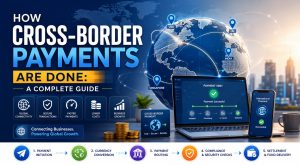
How Are Cross-Border Payments Done?
Although sending money internationally looks like a simple process, there are various steps performed during the execution.
Payment Initiation:
The process begins when a person making the payment to another person living abroad requests their bank or payment service provider to send money to a recipient in another country. To initiate this payment, the person sending money provides the following information to the financial institution:
- Name of the recipient
- Bank account information
- Amount of payment
- Currency details
- Purpose of payment
Once the payment request is submitted, the financial institution starts processing the transaction.
Currency Conversion:
In international transactions, the sender and recipient use different currencies. Therefore, the channel through which the payment is made converts the currency of the sender into the currency applicable in the country of the recipient. This currency is converted on the basis of the applicable exchange rate. The final amount received is calculated on the basis of:
- Fluctuations in exchange
- Fees for converting currency
- Service charges
- Bank markups
This step plays an important role in determining the overall cost of a cross-border transaction.
Movement of Funds:
Once the currency is converted, the payment is initiated through banking networks. In traditional systems, the payment was first sent to the intermediary or correspondent banks before being deposited in the account of the recipient. Depending on the platform used for the payment and banks involved in the transaction, this process can take anywhere from a few minutes to several business days. Modern fintech solutions are reducing the dependence on intermediaries and reducing the time for transactions.
Compliance and Security Checks:
Before transferring the funds in the bank account of the recipient, it is mandatory for financial institutions to follow rules and regulations strictly according to international laws. The financial institution making the payment has to check the following factors:
- Make sure that the money is not being used for anti-money laundering purposes.
- Know Your Customer (KYC) requirements
- Sanctions screening
- Fraud detection measures
Following these rules protects both businesses and consumers from financial crimes and unauthorised transactions.
Settlement and Fund Delivery:
Once all steps are completed, the funds are transferred to the account of the recipient. After receiving the funds, the recipient can withdraw and use the money according to local banking regulations.
Today, with the increasing use of technology, the financial institutions involved in the payment provide the facility of real-time tracking. This allows businesses to check the status of international transactions starting from the time they request the institute to make the payment.
Challenges in Cross-Border Payments:
Despite technological developments, international payments suffer from the following problems:
- High transaction fees to complete the whole process
- Currency conversion costs
- Delayed settlement times
- Complex regulatory requirements
- Limited payment transparency
- Intermediary banking charges
Many organisations are now adopting digital payment platforms and advanced fintech solutions to get rid of these issues and improve the efficiency of payments.
The Role of Fintech in Modern Cross-Border Payments:
Fintech companies are changing the process of making payments across borders. By automating the process, digital infrastructure, and innovative settlement mechanisms, these platforms can offer the following:
- Faster transaction processing
- Competitive exchange rates
- Greater transparency
- Lower operational costs
- Improved customer experience
Efficient international payment systems not only make financial transactions across borders simple but also create new opportunities for companies to expand their business in international markets. Businesses that use the latest payment technologies enjoy improved operational efficiency, better customer satisfaction, and stronger international reach. The growing importance of cross-border payments is enough to reveal the role of smooth financial transactions in expanding business across borders.
Conclusion:
Cross-border payments are the foundation of today’s interconnected global economy. While the process involves multiple stages, including payment initiation, currency conversion, routing, compliance verification, and settlement, advancements in fintech are making international transactions faster, more transparent, and cost-effective.
As businesses continue to expand globally, understanding how cross-border payments work can help them choose the right payment partners, reduce transaction costs, and create a seamless experience for customers and stakeholders worldwide.