Introduction:
The banking industry has undergone dynamic changes during the past few years. Open banking has emerged as one of the notable changes in the banking sector. The use of these APIs allows banks and authorised third-party providers to share their financial data with full security. As a result of these changes, a new relationship is taking place between fintech industries and traditional banks that allows both sectors to collaborate and provide faster, more personalised financial services to customers.
What Are Open Banking APIs?
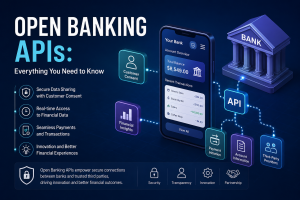
Open Banking APIs (Application Programming Interfaces) are secure digital connections that allow banks to share financial data of customers approved by them with licensed third-party applications. The use of APIs allows systems to communicate with each other instead of sharing financial information manually. The main objective of Open banking is to obtain the consent of customers before sharing it with a third party.
How Do Open Banking APIs Work?
Despite the simple work process, Open Banking APIs follow strict security measures:
- They require approval from the customers in order to be able to access their data in the bank.
- This third-party application then makes a request for an API request to the customer’s bank.
- The bank authenticates the customer’s identification details.
- When the customer’s information is authenticated, the bank only gives out the required information.
- The application uses the data to deliver services such as budgeting, payment initiation, or financial analysis.
The process of data transfer is fully encrypted and follows the financial regulations strictly, which protects sensitive information.
Features of Open Banking APIs:
Open Banking APIs offer enormous features that make digital banking more efficient and customer-friendly.
Secure Data Sharing: Customer data is exchanged with the help of encrypted API connections. This reduces the risks related to managing the financial data manually.
Customer Consent Management: The users have full control over their data. They grant permission to authorised parties to access their sensitive information and can also stop its access based on their preference.
Real-Time Financial Information: It will be easy for businesses and financial technology applications to obtain real-time information about the account balance, transactions, and payment status.
Initiating Payments: Using open banking APIs will make it possible for authorised applications to initiate payments from one bank to another without relying on card systems.
Unified Integration: A number of countries have developed unified API platforms that will make it easy to connect banks and financial technologies.
Advantages of Open Banking APIs:
Improved Customer Experience: Customers will be able to manage all of their bank accounts through a single application, which makes it easier for them to handle their money.
Quick Financial Operations: Through the use of open banking APIs, it will be easier for financial institutions to evaluate credit scores, check accounts, and approve loans.
Greater Innovation: Innovative financial solutions, including investment and savings applications, can be offered by fintech companies through the adoption of open banking.
Lower Transaction Costs: Since these APIs allow payments between two bank accounts, there is no need for card processing networks, and therefore businesses will be able to lower transaction costs.
Better Financial Intelligence: It is possible for businesses to determine their actual financial position, which enables better decision-making, risk assessment, and customer analysis.
Common Applications of Open Banking APIs:
The application of open banking APIs is redefining how transactions within the financial sector are being carried out.
Personalised Financial Management: Budgeting apps will help in organising expenses, assessing spending, and giving personalised financial advice.
Digital Lending: Lending companies will be able to assess income, spending habits, and bank activity before making any decision on the loans.
Account Aggregation: It becomes possible for customers to view several bank accounts from different financial firms through a single dashboard.
Business Accounting: Bookkeeping can become easier since accounting apps are going to automatically update bank transactions.
Fraud Prevention: Real-time bank information will help financial companies to detect any fraudulent activities more easily.
Security Considerations: Security is a matter of prime importance under Open Banking. Financial institutions implement multiple layers of protection, including:
* Strong customer authentication process (SCA)
* OAuth-based secure authorization
* End-to-end encryption
* Token-based API access
* Continuous monitoring for suspicious activities
* Compliance with financial regulations and data privacy laws
Since customers control data-sharing permissions, Open Banking provides greater transparency than traditional data-sharing methods.
Challenges of Open Banking APIs:
Despite their benefits, Open Banking APIs suffer from various challenges:
* The rules and regulations related to their implementation are different in each country.
* The process of initiating a standard API is different in each financial institution.
* The existing banking systems may need to update themselves.
* Customer awareness and trust continue to evolve.
* Cybersecurity requires ongoing investment and monitoring.
Both financial institutions and fintech firms should collaborate in order to address these challenges and provide reliable and secure services.
Future of Open Banking APIs:
The development of the Open Banking API is currently leading to revolutionary changes within the realm of finances, when users will be able to exchange information not only about their accounts but also their insurance, investment and pension details. The use of artificial intelligence, embedded finance and real-time payment systems will broaden the functionality of Open Banking APIs even further.
Conclusion: Open Banking APIs are transforming the financial industry, as they provide opportunities to securely share data between financial institutions and authorised third parties under the control of a customer. These APIs bring benefits such as better customer experience, faster financial services, cost savings and innovations to the whole fintech world. By continuing with the digital transformation of their business processes, organisations may take advantage of Open Banking APIs to gain more opportunities in the future.