Introduction:
The practice of sending money online to anyone in any corner of the world has never been easier than in the current times. Whether you send money to any of your family members living abroad, make a payment to your supplier living in another country, fund international education, or manage business transactions, international money transfers are now a routine part of life. However, financial agencies offering the service of transferring money across borders advertise low fees and competitive rates, but the actual cost of sending money internationally is often higher than it appears.
Understanding these hidden costs can help individuals and businesses in making relevant decisions and avoid unnecessary expenses.
Transfer Fees Are Just the Beginning:
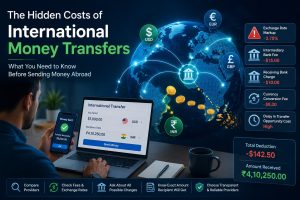
As a general practice, many people consider the transfer fees a major factor while selecting a money transfer provider. Where some money transfer service providers charge a fixed amount, others charge fees as a percentage of the transfer value, this visible charge is only one part of the total cost. Many providers advertise low or even zero transfer fees to attract customers. However, they charge for their services through some not-visible methods, which makes the overall transaction more expensive than expected.
Some of the hidden costs are mentioned below:
Exchange Rate Markups:
One of the highest hidden costs in international money transfers is the exchange rate markup. The exchange rate shown on financial news websites is usually the mid-market rate, which is the actual value of one currency against another.
Many banks and money transfer companies offer customers a less favourable exchange rate. Even a small difference can make a huge difference in the amount received by the beneficiary. For example, a margin of 2% to 4% on a large transfer can be more expensive than the cost told for transferring the money.
Before making a transfer, it is better to compare the exchange rate offered by the money transferer with the current market rate to understand the true cost.
Charges of the Bank Receiving Funds:
In some cases, the bank receiving the money may deduct fees before crediting the funds. These charges are often not clearly disclosed during the transfer process, which creates confusion when the receiver gets less money than expected. The fees of the banks receiving the money may be different according to the country, the bank initiating the transfer and the method of transfer. Understanding this difference can help in avoiding receiving a smaller amount by the recipient.
Intermediary Bank Fees:
There are almost two or more intermediary banks involved in international transfers, especially when using traditional banking networks. There are chances of intermediary banks charging the funds handling fees during the transaction. As these charges are not always predictable, both the sender and recipient may be unaware of the exact amount that will be deducted until the transfer is completed.
Currency Conversion Costs:
Sometimes there are multiple currency conversions involved in an international money transfer before the recipient finally receives the money. During each conversion of currency, a certain amount of additional fees is charged by the banks initiating the process, which can increase the overall cost of the transaction. This problem normally happens in sending money to countries where direct currency exchange options are limited.
Delays and Opportunity Costs:
Hidden costs are not always monetary. Slow processing time in transfers can create financial losses, especially when you have to send money to someone urgently. Due to the delay in transfer, the senders have to pay late payment fees. It is therefore suggested to select a provider that performs all the tasks timely.
How to Reduce Hidden Costs
To minimise expenses when sending money internationally:
* Compare multiple transfer providers before making a transaction.
* Check both transfer fees and exchange rates.
* Ask about intermediary and receiving bank charges.
* Review the estimated amount the recipient will receive.
* Hire money transfer services from reliable providers who clearly disclose all costs.
Conclusion:
International money transfers are an essential financial service, but the charges related to transfer fees reveal the real story. Margin in the exchange rate, charges of the intermediary bank, fees of the bank receiving money, and penalties charged for slow processing of money transfers can all increase the actual cost of a transfer. Understanding these hidden expenses and comparing the charges of money transfer service providers carefully can help senders send money to the recipient on time at cost-effective charges.