Introduction:
The banking world is changing fast. Businesses are using digital tools to manage money, make payments and help customers. Traditional banking is still a part of how businesses manage money, but open banking is bringing in a new way to use data. By letting people and businesses share their details safely with approved apps through APIs, open banking helps make payments faster and gives better insights.
What Is Traditional Banking?
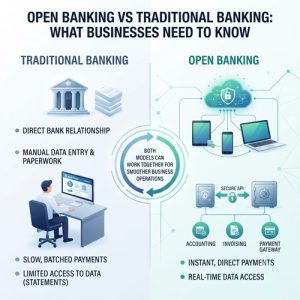
Traditional banking is the way of doing things. In banking, businesses work directly with a bank to manage their accounts, loans and deposits. The bank holds onto all the account info. Businesses usually have to look at bank statements or use a portal to see what is happening.
This way of working is very steady. It has rules and a relationship you can trust. Traditional banking can sometimes be slow. It can be hard to connect a bank to apps, so you might have to type in data by hand. For example, a business might have to download a bank statement and then manually type those numbers into their accounting software.
What Is Open Banking?
Open banking lets businesses and customers share pieces of financial data with approved third-party apps using APIs. If a person gives permission, these apps can see things like how much money’s in an account or what was bought.
Instead of keeping all the money info locked inside one bank, open banking connects banks to fintech companies and accounting tools. This makes it much easier to see your money. Let’s businesses automate their daily tasks.
Open Banking vs Traditional Banking: Key Differences:
The main difference is how easy it is to get to your data. Traditional banking keeps your info inside the bank. Open banking lets approved apps see your data through APIs.
Data access: With banking, you often have to go get your info yourself. Open banking can give you your data instantly and automatically.
Payments:
Traditional banking uses tools like cards or bank transfers. Open banking allows money to move directly from one bank account to another. This direct movement of money can sometimes be cheaper for you.
Automation:
Traditional banking often means you have to use spreadsheets and do math by hand. Open banking connects your bank info to your invoicing and accounting tools. This connection makes your work much easier.
Innovation:
Traditional banking mostly offers what the bank itself provides. Open banking lets new tech companies build new tools on top of the banks we already use.
Customer control:
Open banking works because the customer says “yes”. You get to choose which apps are allowed to see your info.
Benefits of Open Banking for Businesses:
The open banking system offers many benefits to businesses of all types. One of the most notable benefits is the ability to stay updated with information about income and earnings. A business can see all their accounts in one single place. This makes it easy to track money coming in and money going out.
Open banking also makes payments faster. Cuts down on boring paperwork. You can link your bank to your accounting system so the software tracks payments for you. Another interesting benefit is getting money faster. If a business shares its data with a lender, there is paperwork, and the lender can make a decision much quicker.
Open banking also helps businesses find deals because they can easily compare different tech companies.
Challenges Businesses Should Consider:
Besides benefits, open banking has some risks. Money data is very private. Because of this, businesses need strong security and strict rules about who can see what. Being more connected can also mean chances for hackers to try something.
Businesses also need to think about the cost of setting things up. If the APIs are reliable. It is very important to be clear with customers about how their data’s being used.
Which Banking Model Is Better for Businesses?
You do not have to pick one. Open banking and traditional banking do not have to fight each other. In some cases, open banking just makes traditional banking better. A business can keep its accounts at a bank and then use open banking APIs to connect those accounts to smart digital tools.
If a company wants to work and see their money better, open banking is a great choice. Traditional banking is still needed for things like keeping deposits safe and getting loans.
Choosing between open banking and traditional banking depends on what a business needs and how they want to use technology. Traditional banking gives you a foundation you can trust. Open banking adds speed, automation and new ways to manage money.
As more businesses move toward tools, using both traditional banking and open banking together can help a business run much more smoothly.