Introduction:
The entrance of digitisation in banking services, financial technologies, online payments, and financial services has changed the way businesses engage and manage their customers. Nevertheless, the move towards digital solutions has created additional issues associated with financial crime, fraud, and compliance. The process of automating KYC and AML checks is proving to be an efficient method of improving efficiency in terms of performing compliance checks while increasing precision and the speed of detecting risks.
Understanding KYC and AML:
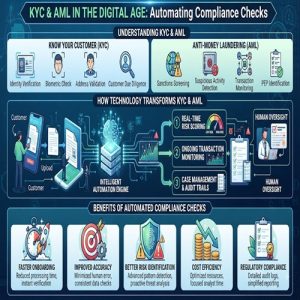
Know Your Customer (KYC) is a set of procedures used by organisations to verify the identities of their customers before establishing a business relationship and/or throughout the relationship. The procedures might consist of identification document verification, address verification, beneficial ownership validation, and assessing customer risk.
Anti-Money Laundering (AML) represents the measures that are put into place by financial institutions and companies in order to prevent the misuse of their services for money laundering, terrorist financing, and any other forms of financial crimes. AML programmes consist of customer due diligence, sanctions screening, transaction monitoring, and suspicious activity detection.
Why Can Conventional Compliance Procedures Be Complex?
Conventional KYC and AML procedures can rely a lot on manual document reviews, searches within databases, and repeating verification activities. With an increasing number of customers, such procedures can be expensive and lengthy.
Moreover, manual checks can lead to inconsistencies. Compliance staff will need to review numerous documents, look into alerts and decide if any transaction requires additional checking. Numerous false-positive AML alerts will only add to the work of compliance officers.
In the case of digitally orientated companies, conventional procedures can negatively impact customer experience. Customers become increasingly demanding about fast onboarding, while organisations should comply with regulatory requirements.
How Does Technology Transform KYC and AML?
New compliance software uses artificial intelligence, machine learning, OCR, workflow automation and data analytics for automating repetitive actions. With digital onboarding, automatic systems can take information from identity documents, perform a comparison of customer information with reliable databases and spot any inconsistencies. Also, biometric verification can help to make sure that the person with the identity document is the owner of the document.
AML automation is not limited to onboarding alone. Customer screening for sanctions and politically exposed persons (PEPs) lists can be ongoing; transactions and suspicious patterns can be monitored and identified. AI systems are capable of processing huge amounts of data and prioritising the most risky cases for human investigation. The current trends in the industry also indicate a shift towards more dynamic as opposed to periodic KYC monitoring.
Benefits of Automated Compliance Checks:
Faster Customer Onboarding: As a result of automatic identification of clients, the amount of time necessary to complete the KYC checks and let legitimate clients use your services is shortened.
Improved Accuracy: Automating the processes helps eliminate mistakes caused by repetitive and boring data entry. Moreover, AI can detect patterns that may go unnoticed with a simple manual check.
Better Risk Identification: With AML automation, you can analyse transaction behaviour, customer profiles and geolocation data among other risk factors, and spot suspicious activities.
Cost Efficiency: By automating repetitive compliance tasks, your company will allow compliance officers to concentrate on investigations and other important issues.
Improved Auditability: Automated workflows can keep logs of the verification process, alerts, decision-making and escalation events. This helps in developing an audit trail that is clear and can be easily reviewed during regulatory compliance.
Human Supervision Role: It is important to note that automation doesn’t necessarily imply the absence of compliance officers from the process. AI tools and automation must help in decision-making, especially in matters that are complex and risky. An effective way will be the use of automated screening and risk assessment together with human oversight of the exceptional decisions and cases.
Developing the Future of Digital Compliance:
With technology driving financial services, the KYC and AML processes need to become quicker and smarter while remaining risk-aware all the time. Firms can incorporate automated identity verification, sanctions screening, transaction monitoring, risk scoring and case management into their compliance workflow.
This is not only about the automation of compliance procedures but also a risk-based, data-driven and continually monitored compliance environment. Organisations that employ automation, together with sound governance and oversight practices, would be able to provide a superior customer experience as well as improve their capacity to detect financial crimes. Hence, automation of KYC/AML in the age of digitisation is one of the key aspects of financial compliance.
Frequently Asked Questions:
- What are KYC and AML in financial services?
Know Your Customer (KYC) is the process of verifying a customer’s identity and assessing relevant risks before or during a business relationship. Anti-Money Laundering (AML) refers to the policies, procedures, and controls financial institutions use to detect and prevent money laundering and related financial crimes.
- How is KYC and AML compliance automated?
KYC and AML compliance can be automated using digital identity verification, document recognition, database screening, transaction monitoring, and risk-scoring systems. These technologies help financial institutions streamline checks and flag cases that require further investigation.
- What technologies are used to automate KYC and AML checks?
Common technologies include artificial intelligence (AI), machine learning, optical character recognition (OCR), biometric verification, robotic process automation (RPA), and data analytics. These tools help process customer information, identify suspicious patterns, and support compliance workflows.
- What are the benefits of automated KYC and AML compliance?
Automated KYC and AML systems can reduce manual workloads, speed up customer onboarding, improve consistency, support real-time transaction monitoring, and help identify potential risks. Their effectiveness depends on data quality, system configuration, and ongoing oversight.
- How does AI improve KYC verification?
AI can help analyse identity documents, extract customer information, detect inconsistencies, and support facial verification and risk assessment. It can make verification workflows more efficient, but human review may still be necessary for unclear or high-risk cases.
- How does transaction monitoring help prevent money laundering?
Transaction monitoring analyses financial activities to identify unusual patterns, transactions, or behaviours that may indicate money laundering. Automated systems can generate alerts for compliance teams to investigate and determine whether further action or reporting is required.
- What is the difference between KYC and AML?
KYC focuses primarily on identifying customers, verifying their information, and understanding their risk profiles. AML is broader and includes monitoring transactions, assessing financial crime risks, investigating suspicious activities, and meeting applicable reporting obligations. KYC is an important part of an AML compliance programme.
- What challenges do financial institutions face when automating KYC and AML checks?
Common challenges include data privacy concerns, integration with legacy systems, false-positive alerts, incomplete customer records, cybersecurity threats, and changing regulatory requirements. Financial institutions need reliable data, regular system testing, and appropriate human oversight to address these challenges.
- How does automated KYC and AML compliance improve customer onboarding?
Automated compliance systems can verify identity documents, validate customer information, and perform screening checks more quickly than many manual processes. This can reduce onboarding delays while helping financial institutions identify customers who require additional verification.
- What is the future of KYC and AML compliance automation?
KYC and AML automation is likely to make greater use of AI-driven risk assessment, digital identity verification, continuous monitoring, and improved data-sharing technologies. Future developments will depend on regulatory acceptance, privacy safeguards, system accuracy, and the ability to explain automated decisions.