Overview:
The way of using financial services has changed dynamically in recent years across the world. Today, customers can pay for purchases, apply for loans, buy insurance, or use digital wallets without ever visiting a banking website or branch. The major role in all these transactions is played by embedded finance, a fintech innovation that integrates financial services directly into non-financial platforms. With the increasing adoption of this approach by businesses, embedded finance solutions are providing the facility of enjoying smooth financial services without standing in queues and performing huge amounts of paperwork. This not only enhances customer experience but also generates new revenue opportunities.
What Is Embedded Finance?
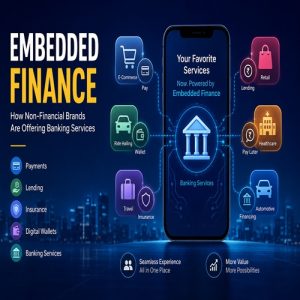
Embedded finance refers to the integration of financial products and services into the digital platforms of non-financial businesses. Now the customers don’t have to visit a bank or any financial institution to make payments, apply for loans, pay insurance premiums, or perform any other financial task; they can perform all these activities from anywhere within the same application or website.
All this is possible through Banking-as-a-Service (BaaS), which enables licensed financial institutions to provide secure banking infrastructure through APIs. Businesses can then embed these capabilities into their digital platforms while banks continue to manage compliance, regulations, and financial operations behind the scenes. The success of this model is largely driven by fintech partnerships with traditional banks, allowing financial expertise and innovative technology to work together.
Common Types of Embedded Financial Services:
Embedded financial services are not limited to processing payments only; they also include a wide range of additional services that are designed to enhance the convenience of customers.
- Embedded Payments: The customers have an easy payment option for any services and products that they buy without getting off the platform.
- Embedded Lending: Companies provide the options of instant financing, loans, and Buy Now, Pay Later (BNPL).
- Embedded Insurance: Travel firms, retail firms, and auto firms provide insurance facilities at the time of purchase.
- Digital Wallets: Customers can store their money and earn rewards while making payments.
- Embedded Banking: There are certain companies that provide debit cards and savings accounts to their customers.
Benefits for Businesses and Customers:
The use of embedded finance has made the process of financial transactions simpler and faster for both businesses and consumers. By embedding financial services in their operations, businesses not only retain their users but also increase their engagement by providing additional services. All these activities help in increasing their revenue in the form of transaction fees. It also provides valuable customer insights that support personalised services and better decision-making.
On the other side, customers enjoy the facility of performing faster transactions, reduced paperwork, convenient financing options, and a more seamless digital experience. Now customers don’t need to switch between multiple platforms; they can complete purchases and manage financial services in one place.
Real-Life Uses:
Embedded banking is revolutionising many different sectors. E-commerce sites give consumers various payment choices and merchant finance facilities. Ride-sharing and delivery services have on-the-road payment systems and digital wallets for drivers, while travel agencies include travel insurance and payments in their reservation system, whereas automobile companies have financing, insurance, and subscriptions within their digital platforms.
Technologies Behind Embedded Finance:
There are a few new technologies making embedded banking services feasible.
Banking-as-a-Service (BaaS) provides a regulated banking environment, while APIs assist with secure communication between banks and digital platforms. Moreover, Open Banking, artificial intelligence, cloud computing, and digital identity verification enable quicker approvals, personalised financial products, fraud protection, and security. All of these technologies help businesses provide banking services without being a bank.
Challenges Ahead:
Even though embedded finance is rapidly gaining popularity, there are still some challenges that businesses need to face in order to offer this innovative solution. These include regulatory compliance, security of customer data, protection against fraud and selecting trustworthy financial partners. Building consumer trust by offering strong cybersecurity solutions and protecting customers’ data is the priority for any business.
As time goes on, embedded finance will become the standard solution among many different industries. The development of API-driven ecosystems, artificial intelligence and Open Banking will allow even more businesses to incorporate the features of the banking services into their customer journey. In this way, consumers will be able to enjoy more personalised, accessible and convenient financial services.
Conclusion:
Embedded finance is revolutionising the way consumers interact with banking services as it allows the incorporation of the features of banking directly into the platform consumers use on a daily basis. Through various solutions, including payment, lending, insurance and digital wallets, businesses will not only provide a great customer experience but also find ways for growth.
Frequently Asked Questions (FAQs):
What is embedded finance?
‘Embedded finance’ refers to the integration of financial services such as payments, loans, insurance, and banking services in non-financial platforms such as e-commerce sites, travel applications, and ride-sharing applications. It means that users can access the financial services without having to visit banks.
How does embedded finance work?
Embedded finance is achieved through Banking as a Service (BaaS) and application programming interfaces (APIs). Financial firms will provide banking services securely, and firms using the services will integrate the services into their platforms, enabling customers to carry out transactions via the platforms.
What are the different types of embedded financial services?
Some of the different types of embedded financial services include:
• Embedded payments
• Lending services, Buy Now Pay Later (BNPL)
• Insurances
• Digital wallets
• Banking services such as debit cards and savings accounts
How does embedded finance benefit businesses?
Embedded finance helps businesses to improve customer engagement and customer retention, earn additional revenue from transaction fees, collect valuable customer data, and offer customised financial services to customers.
What are the benefits of embedded finance to clients?
Clients get quick transactions, easy payment processes, less paperwork, fast access to funding, smooth digital interaction, and the possibility to get different financial services from one platform.
For which industries is embedded finance beneficial?
Embedded finance is implemented by e-commerce companies, retailers, travel companies, ride-hailing companies, food delivery companies, automobile companies, healthcare companies, and other digital platforms that offer financial services for their customers.
What is BaaS in embedded finance?
BaaS (Banking-as-a-Service) is a model wherein licensed banks provide the banking infrastructure through APIs and help non-financial companies to offer banking services without being banks.
What technologies support embedded finance?
Embedded finance involves technologies such as BaaS, APIs, Open Banking, artificial intelligence (AI), cloud technology, and digital identity verification.
What challenges are involved in embedded finance?
The major challenges in embedded finance involve regulatory compliance, cybersecurity, fraud, client data security, and trustworthy selection of financial partners.
Is embedded finance secure?
Yes, it is safe to say that embedded finance is very safe owing to regulated banking partnerships, encryption in APIs, security measures, and other financial regulations.
How is embedded finance different from traditional banking?
Embedded finance differs from traditional banking due to the requirement to go to a bank or using a banking application to access its financial services. Embedded financial services allow the customer to conduct financial operations quickly and without any difficulties.
What is the future of embedded finance?
The future of embedded finance depends on technological developments such as open banking, artificial intelligence, cloud computing, and API ecosystems. There will be more organisations embedding financial services into their applications.