Introduction:
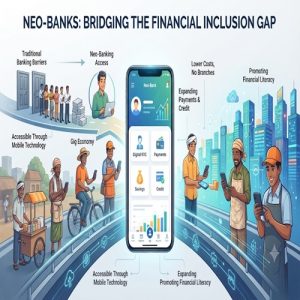
Equal access to financial services is crucial for creating a more equitable economy. However, millions of people across the world still remain deprived of financial services or have only limited access to them. Traditional banks often make it hard to get access because of the need to visit branches, complicated paperwork, minimum balance rules and high fees. Neo-banks are helping to change this by offering banking and financial services through platforms. This makes financial services easier to reach for people who’re unbanked or underbanked.
What Are Neo-Banks?
Neo-banks are financial service providers that focus on platforms. They work mostly through apps and websites instead of relying on physical branches. They use technologies like cloud computing, APIs, artificial intelligence, automation and digital KYC (Know Your Customer) to deliver their services. In countries like India, many neo-banking platforms do not operate as banks. Instead, they partner with banks. This way, fintech companies can offer digital experiences while using regulated banking systems.
Making Banking Accessible Through Mobile Technology:
One of the strengths of neo-banks is how accessible they are. People can. Manage bank accounts using just a smartphone. They do not need to go to a branch. This is especially helpful for people in areas where informal workers, freelancers and small business owners live. These groups often find traditional banks hard to use.
Digital onboarding and e-KYC make the account opening process faster and simpler. Instead of dealing with long paper forms and in-person visits, customers can verify their identity online. This speeds up access to services. Studies on neo-banking show that branchless delivery, digital KYC and mobile banking are tools for reaching people who are left out of the formal financial system.
Reducing the Cost of Financial Services:
Cost is an issue for many people who want to use financial services. Running branches and traditional banking systems is expensive. This cost is often passed on to customers in areas with fewer users.
Neo-banks run online. They use systems to keep their operations lean. This allows them to offer lower-cost services. They can provide payment accounts, money transfer tools, savings options and other financial products to people who were once ignored by mainstream banks.
Expanding Access to Payments and Credit:
Neo-banks also help people take part in the economy. Digital payment tools let individuals and small businesses send and receive money easily. These transactions create records of financial activity. This can be useful for building trust with lenders.
For people with limited or no traditional credit history, neo-banks can use data- and technology-based credit scoring. This helps people get loans. This is especially useful for gig workers, micro-businesses and others who may not have documents or credit records.
India’s digital financial system shows how technology can help. UPI allows mobile payments. Digital identity and account systems have expanded access to finance. By April 2026, India had over 58 crore Jan Dhan accounts. This shows how large and effective the financial inclusion system can be.
Promoting Financial Literacy and Personalised Banking:
Inclusion is not just about opening an account. It is also about helping people use products safely and wisely. Neo-banks can include tools like budgeting apps, spending insights, alerts, educational articles and personalised recommendations in their apps.
Artificial intelligence can support this by studying customer behaviour. This helps banks offer products that match the needs of each user. For people who’re underserved, personalised digital experiences can make banking easier to understand and use.
Challenges That Neo-Banks Must Address:
With their potential, neo-banks cannot fix financial exclusion by themselves. There are still challenges. These include digital literacy, unreliable internet, cybersecurity threats, privacy issues and weak consumer protection.
There is also a risk that people without smartphones, internet access or digital skills might be left behind. The shift to finance could exclude those who are already vulnerable.
Strong regulation and cooperation are needed between fintech companies, traditional banks, governments and technology providers. Financial innovation must be paired with lending, clear pricing, strong security and good customer support.
The Future of Financial Inclusion:
Neo-banks are changing the way banking works. They bring services closer to customers using technology. Their mobile-first, cost- and customer-focused models can help connect underserved populations with payments, savings, credit and other financial tools.
As infrastructure, artificial intelligence, open finance and embedded financial services keep growing, neo-banks could play a bigger role in reducing financial exclusion. The best results will come when technology is combined with regulation, digital literacy programmes, consumer protection and inclusive design. In this way, neo-banking can become a bridge between those who have been left behind and the modern digital economy.