Introduction:
The growing trend of conducting financial operations online makes it necessary for companies to adhere to the regulations of Anti-Money Laundering (AML). This is what is required from banks, fintech firms, payment providers, and crypto exchanges while providing seamless services to their customers. This is where AML compliance software can play an interesting role. With a sound AML system, customer verification, transaction monitoring, risk assessment, and regulatory reporting become automated, thus allowing organisations to reduce financial crimes and stay compliant. For those businesses that create digital wallet fintech solutions, AML capabilities become crucial.
What Is AML Compliance Software?
AML compliance software is a technology that helps organisations identify, investigate, and report suspicious financial activities related to money laundering, fraud, or terrorist financing. The notable feature of this compliance software is that it helps businesses to check their customers, monitor transactions, assign risk scores and generate compliance reports automatically, instead of performing all these activities manually.
Sectors that commonly make use of AML software are:
• Banks and financial institutions
• Fintech startups
• Cryptocurrency exchanges
• Digital payment providers
• Insurance companies
• Investment firms
As rules and regulations related to financial transactions become stricter across the world, the relevance of automated AML systems becomes an essential component of modern financial infrastructure.
Main Features of AML Compliance Software:
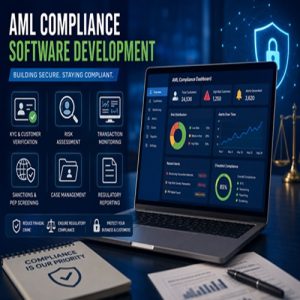
An effective AML platform is enriched with multiple compliance modules to provide complete protection throughout the customer lifecycle:
Customer Verification (KYC):
Know Your Customer (KYC) is the foundation of every AML system. This entails ensuring the validity of the documents presented by the customers, confirming the details of the customer, doing biometric checks when needed, and performing Customer Due Diligence (CDD).
Intelligent Risk Assessment:
The customer is issued with a risk score which depends on various criteria like geographic location, occupation, source of money, transaction history, among others. Customers identified as high-risk can then undergo Enhanced Due Diligence (EDD).
Real-Time Transaction Monitoring:
It is one of the most difficult components of AML software. It involves uninterrupted monitoring of transactions. The system automatically analyses payment activities and detects unusual behaviour, including:
• Large or unexpected fund transfers
• Structuring or smurfing transactions
• Rapid movement of funds
• Cross-border payment anomalies
• Unusual account behaviour
Automated monitoring enables compliance teams to identify suspicious activities much faster than traditional manual reviews.
Sanctions and PEP Screening:
AML software should continuously screen customers against global sanctions lists, Politically Exposed Persons (PEPs), and adverse media databases. Continuous screening ensures businesses remain compliant even when regulatory lists are updated.
Case Management and Regulatory Reporting:
Once suspicious activities are detected, compliance officers need an effective case management system to investigate alerts, record findings, assign cases, and generate Suspicious Activity Reports (SARs) or Suspicious Transaction Reports (STRs) for regulators.
Steps to Develop AML Compliance Software:
Developing an AML platform starts with understanding the regulatory requirements applicable in a particular country. This is because different AML regulations are applicable in each country, and therefore it is imperative for development teams to collaborate closely with legal and compliance experts during the development process.
The next step involves designing a scalable software architecture that can be upgraded according to existing conditions. Many modern AML platforms use a microservices architecture where KYC, sanctions screening, transaction monitoring, reporting, and alert management operate as independent services. This helps in enhancing scalability, simplifies maintenance, and allows organisations to process millions of financial transactions efficiently.
Security Considerations:
Since AML platforms process highly sensitive financial and personal information, it is highly important to pay attention towards security at every phase of development. End-to-end encryption, multi-factor authentication, role-based access control, API authentication, and audit logging must be included in the development process.
It goes without saying that organisations should regularly conduct vulnerability assessments and penetration testing to detect any weaknesses before hackers can use them against an organisation. Following best practices in cybersecurity in the financial sector will not only help keep sensitive customer data protected but will also improve regulatory compliance of the organisation.
Conclusion:
The AML compliance software has become an important element of the strategy for the organisations functioning in the modern digital finance environment. An efficient software will include customer verification, risk assessment, transaction monitoring, sanctions screening, intelligent reporting, and security. With the use of automation, artificial intelligence, and effective cybersecurity measures, organisations will be able to fight financial crime and simplify the process of regulatory compliance.
Frequently Asked Questions:
1. What is AML compliance software?
AML compliance software is automated software used to identify, prevent, and report any suspicious activity in financial transactions such as money laundering, fraud, and terrorism financing.
2. Why is it necessary for financial institutions to have AML compliance software?
Financial institutions use AML compliance software to ensure that they are performing their duties as per industry norms. The use of this software helps in reducing the risks of financial crimes and improving efficiency in their work.
3. For which industries is the use of AML compliance software beneficial?
The most popular industries using AML software include the following:
- Banks and financial institutions
- Fintech companies
- Cryptocurrency exchanges
- Digital payment providers
- Insurance companies
- Investment firms
- Digital wallet providers
All these organisations perform a wide range of financial transactions.
4. What are the main features of AML compliance software?
- Know Your Customer (KYC) verification
- Customer due diligence (CDD)
- Risk assessment and scoring
- Transaction monitoring
- Sanctions and PEP screening
- Case management
- Regulatory reporting (SARs and STRs)
The common features offered in the software are:
5. How does AML software carry out customer verification?
AML software conducts customer verification through KYC practices, document verification, biometric identification where possible, and Customer Due Diligence (CDD).
6. Explain transaction monitoring in AML software.
Transaction monitoring is the process of analysing customer transactions and detecting any suspicious financial activities. The software analyses irregularities like fund transfer, structuring (smurfing), fast fund movements, cross-border issues, and other such suspicious behaviour.
7. What is risk assessment in AML compliance software?
Risk assessment entails assigning a risk score to every customer based on the geography of the customer, occupation, fund sources, and transaction history. High-risk clients are put through the Enhanced Due Diligence (EDD) process.
8. What is PEP and sanctions screening?
PEP and sanctions screening involves screening customers against the world sanctions list, politically exposed persons (PEPs), and adverse media databases. The screening process is ongoing to ensure compliance as the databases keep changing.
9. What security features should be included in the AML compliance software?
AML compliance software must have a variety of security features such as end-to-end encryption, multi-factor authentication (MFA), role-based access control (RBAC), secure API authentication, auditing logs, vulnerability assessment, and penetration testing for the protection of financial information.
10. What is involved in developing AML compliance software?
Development of AML compliance software starts from the analysis of AML requirements of the country. Then the developers create an efficient architectural design based on microservices to develop such modules as KYC, transaction monitoring, sanctions screening, reporting, and alerts management.
11. Is it possible to integrate AML compliance software with fintech platforms?
Yes. AML compliance software can be integrated into banking systems, payment gateways, digital wallets, cryptocurrency exchanges, and other fintech platforms via secured APIs.
12. How does the AML compliance software reduce financial crimes?
With the use of AML compliance software, it becomes possible to automate customers’ verification, transaction monitoring, detection of any suspicious activity, and generation of reports required by regulations.